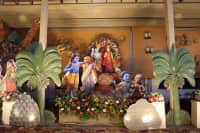
Welcome to / Iskcon Moradabad

Welcome to
Iskcon Moradabad

Experience divine love and spiritual awakening in the heart of Moradabad. Join our community of devotees in worship, service, and celebration.

A Sacred Journey of Devotion

ISKCON Moradabad stands as a beacon of spiritual light, fostering devotion to Lord Krishna through daily worship, community service, and the distribution of prasadam. Our temple welcomes all souls seeking divine connection and inner peace.

Read Our Story

Daily Aarti & Temple Timings

Join us for our daily worship schedule and experience divine bliss

Mangala Aarti

4:30 AM

Early morning worship to awaken the Lord

Tulsi Aarti

5:00 AM

Sacred worship of Tulsi Devi

Guru Puja

7:30 AM

Honoring our spiritual masters

Bhagavatam Class

8:00 AM

Daily bhagavatam classes for spiritual growth

Utthapan Aarti

4:30 PM

Afternoon awakening ceremony

Sandhya Aarti

7:00 PM

Evening worship with devotional songs

Special Programs

Join our community events and spiritual gatherings

Sunday Feast

Every Sunday

12:00 PM

Join our weekly community feast with delicious prasadam and spiritual discourse

Spiritual Discourse

Daily

8:00 AM

Morning spiritual teachings from Bhagavad Gita and Srimad Bhagavatam

Spiritual Discourse

Meeting ID: 3517814984

Passcode: haribol

Bhajan Sandhya

Daily

7:00 PM

Evening devotional singing and meditation to connect with the divine

Upcoming Events

Don't miss our special celebrations and festivals

Pandava Nirjala Ekadashi

2026-06-25

## Pandava Nirjala Ekadashi – Full Story (Katha), Significance, and Observance **Pandava Nirjala Ekadashi** is considered one of the most important Ekadashis in the Vaishnava tradition. It falls during the bright fortnight (Shukla Paksha) of the month of Jyeshtha (May–June). It is called: * **Nirjala Ekadashi** ("nir" = without, "jala" = water) * **Bhima Ekadashi** * **Pandava Ekadashi** The word *Nirjala* refers to the strict observance of fasting **without food and water** for the entire Ekadashi day. --- # The Full Katha (Traditional Story) The story is found in the Vaishnava tradition and is narrated by **Sri Veda Vyasa** to **Bhimasena**, one of the five Pandava brothers. ### Bhima's Difficulty Among the Pandavas, Bhima was known for his immense strength and appetite. Unlike his brothers **Yudhishthira**, **Arjuna**, **Nakula**, and **Sahadeva**, Bhima found it extremely difficult to observe the regular Ekadashi fasts that occur twice every lunar month. His mother **Kunti**, his brothers, and his wife **Draupadi** all faithfully observed Ekadashi. Bhima said: "I can worship Lord Vishnu, perform charity, and engage in devotional activities, but I cannot tolerate hunger. The fire of digestion within me is so powerful that I must eat." Because of this, he approached his grandfather and spiritual guide, **Veda Vyasa**, seeking a solution. --- ### Bhima Approaches Vyasa Bhima respectfully asked: > "O revered grandfather, everyone advises me to observe Ekadashi fasts. But I am unable to fast twice every month. Is there a single fast that can give me the benefit of observing all Ekadashis throughout the year?" Vyasa was pleased by Bhima's sincerity. He replied: > "If you desire the spiritual merit obtained from all the Ekadashis, then observe the Ekadashi that falls in the bright fortnight of Jyeshtha month. On that day, do not consume food or water." This was the Ekadashi that later became known as **Nirjala Ekadashi**. --- ### Vyasa's Instructions Vyasa instructed Bhima: * Fast completely from sunrise on Ekadashi. * Do not drink even water. * Spend the day remembering Lord Vishnu. * Chant the holy names of God. * Stay awake as much as possible in devotional activities. * Break the fast properly on Dwadashi (the next day). Vyasa explained that this one strict observance grants the merit of all twenty-four Ekadashis observed during the year. --- ### The Promise of the Fast Vyasa told Bhima: > "One who faithfully observes this Nirjala Ekadashi receives the benefits of all Ekadashis and becomes freed from many sins." The scriptures describe that messengers of Lord Vishnu (Vishnudutas) protect such devotees, and the devotee advances spiritually through sincere observance. --- ### Bhima Observes the Fast Bhima accepted the challenge. Although it was extremely difficult due to his great appetite, he successfully completed the fast without food or water. Because Bhima observed it, the Ekadashi became famous as **Bhima Ekadashi** or **Pandava Nirjala Ekadashi**. --- # Spiritual Significance In Vaishnava traditions, Ekadashi is dedicated to Lord Vishnu. The purpose of fasting is not merely avoiding food; it is: * Increasing remembrance of God * Practicing self-control * Reducing attachment to bodily comforts * Engaging more deeply in prayer, chanting, and scripture Nirjala Ekadashi is viewed as a day of extraordinary dedication because the devotee voluntarily gives up even water while focusing on spiritual activities. --- # How ISKCON Devotees Commonly Observe It Many devotees: 1. Rise early during Brahma Muhurta. 2. Bathe and wear clean clothes. 3. Attend mangala-arati. 4. Chant extra rounds of the Hare Krishna maha-mantra: **Hare Krishna Hare Krishna Krishna Krishna Hare Hare Hare Rama Hare Rama Rama Rama Hare Hare** 5. Read scriptures such as: * Bhagavad Gita * Srimad Bhagavatam 6. Observe a complete fast if physically able. 7. Spend the day in kirtan and devotional service. 8. Break the fast on Dwadashi during the prescribed parana time. --- # Charity Recommended on Nirjala Ekadashi Traditional texts praise donations such as: * Water * Earthen water pots * Fruits * Clothes * Umbrellas * Food for the needy * Donations to temples and charitable causes Because the festival occurs during the hot season, donating water is considered especially meritorious. --- # Who Should Not Attempt a Strict Nirjala Fast? A complete fast without water can be physically demanding. People who are: * Elderly * Pregnant * Nursing * Ill * Diabetic * Taking medications requiring hydration often follow a modified observance according to their health needs and spiritual guidance. In ISKCON and many other traditions, preserving health is important; devotees may adjust the fast while maintaining devotional practices. --- # Main Lesson of the Katha The story is not primarily about enduring thirst. Its deeper message is that: * Sincere devotion matters more than physical ability. * Even someone who struggles with fasting, like Bhima, can attain spiritual benefit through determination and faith. * Self-discipline offered in service to God can strengthen spiritual life. For devotees, Pandava Nirjala Ekadashi is remembered as Bhima's great act of devotion and dedication to Lord Vishnu.